Humidity
Relative humidity monitoring to protect quality, equipment, and worker conditions.
Variants
Combined temperature and humidity sensors are the most common deployment, providing both readings from a single device since the two measurements are frequently needed together.
Standard humidity sensors cover typical commercial ranges (10–90% RH) for kitchens, storage areas, and dining spaces. High-humidity deployments use sealed housings rated for condensation-prone environments like walk-in coolers and produce storage.
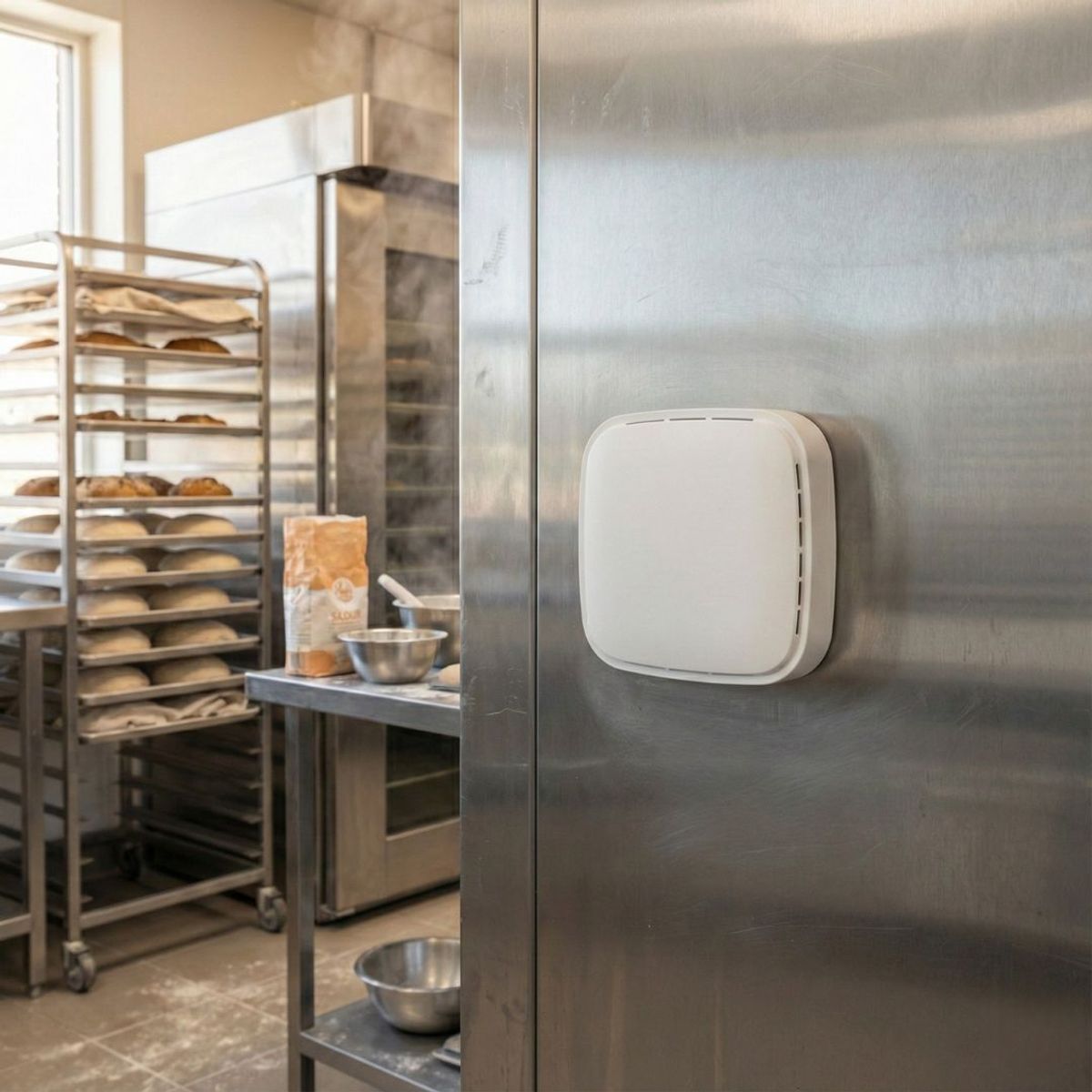
Compact wall-mount and shelf-mount form factors fit inside display cases, bakery proofing cabinets, and storage rooms without taking up usable space.
Why It Matters
Humidity directly impacts food quality, shelf life, and safety. Too much moisture accelerates mold growth and bacterial contamination, while too little causes dehydration, cracking, and weight loss in fresh products.
For bakeries, precise humidity control during proofing and storage is the difference between consistent product quality and daily waste from over-proofed dough, stale bread, or cracked pastries.
Continuous humidity logging replaces manual spot-checks with trend data that reveals patterns — like humidity spikes during cleaning cycles or drops when HVAC systems cycle off overnight.
Use Cases
Bakery and pastry monitoring — track humidity in proofing cabinets, display cases, and storage rooms to maintain product consistency and reduce waste.
Produce and floral storage — ensure humidity stays within optimal ranges to maximize shelf life and minimize shrinkage.
Worker heat safety — combine humidity with temperature data to calculate heat index for Cal/OSHA compliance in indoor environments.
Display case management — monitor humidity in open and closed merchandising cases to protect product quality and appearance.
Limitations
Humidity sensors can be affected by direct contact with water, steam, or condensation. Placement should avoid direct exposure to steam sources, spray cleaning, or dripping condensation.
Accuracy varies with proximity to moisture sources and airflow patterns. A sensor near an open cooler door or steam table may read differently than one in the center of the room. Installation placement is determined based on the specific monitoring goal.