Cooling Log Requirements: The Two-Stage Rule and How to Actually Pass
Two-stage cooling in depth: why cooling is the most-failed food safety process, what a compliant cooling log contains, and how to automate the whole record.
No temperature process in food service fails more often than cooling — and no paperwork gets pencil-whipped more often than the cooling log. This guide covers the two-stage rule in depth, why cooling tops the violation charts, what a compliant cooling log actually contains, and how operators are automating the whole thing.
The two-stage cooling rule, in depth
Per the FDA Food Code 2022 (Section 3-501.14), cooked TCS food must cool from 135°F to 70°F within 2 hours, then from 70°F to 41°F or below within 4 more hours — 6 hours total. Food prepped from room-temperature ingredients must reach 41°F within 4 hours.
The first stage gets the tighter clock because 135°F down to 70°F spans the most dangerous stretch of the danger zone, where bacteria can double in as little as 20 minutes. Miss the two-hour mark and the Food Code gives you exactly two options: reheat to 165°F and start the cool-down over, or throw the food away. There is no third option where you quietly keep going.
The rule is also asymmetric on purpose: passing stage one early does not extend stage two. The whole journey from 135°F to 41°F must finish inside 6 hours.
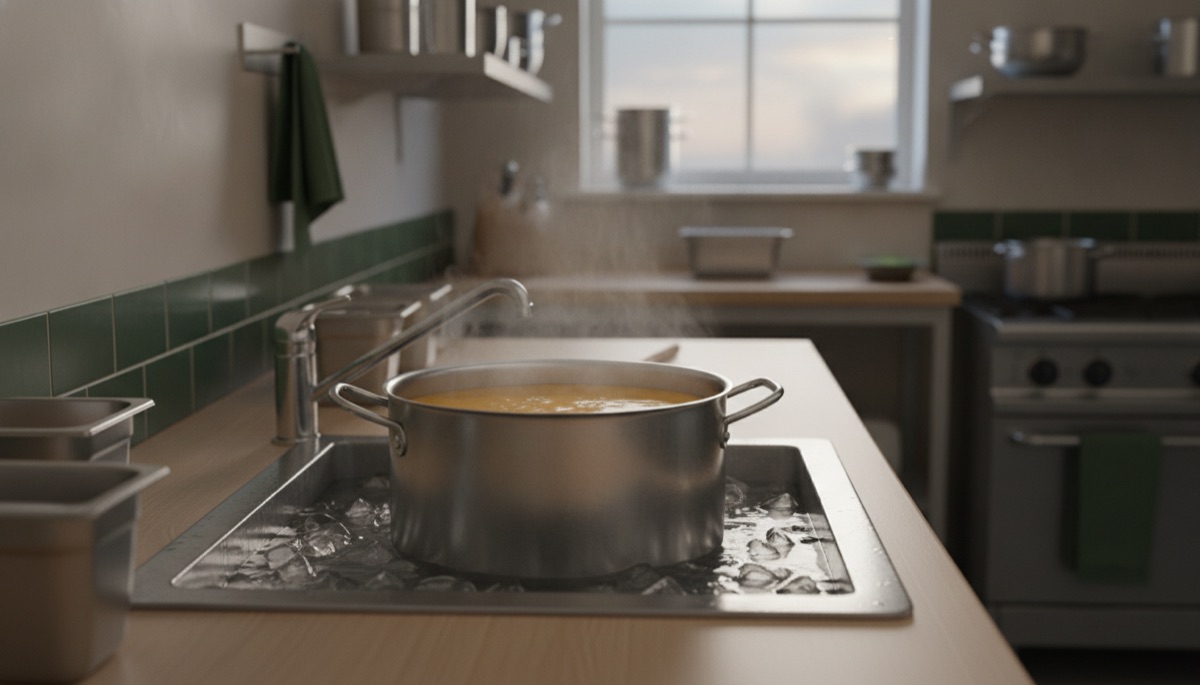
The Food Code also cares how you cool. Recognized methods include shallow pans, smaller portions, ice baths, ice as an ingredient, blast chillers, and containers left loosely covered so heat can escape. A sealed cambro of hot rice on a walk-in shelf technically uses refrigeration and still fails the clock nearly every time — the method, not the walk-in, decides whether the curve makes it.
Why cooling is the #1 violation category
In FDA’s Retail Food Risk Factor Study, improper cooling was found in roughly three out of four establishments where inspectors observed TCS food being cooled — making it one of the most consistently out-of-compliance practices in the entire study.
The reasons are structural. A cool-down that starts after the dinner rush finishes long after the closing crew has gone home, so nobody is there to take the readings that matter. Deep pans, covered containers, and full batches cool far slower than anyone assumes — a stockpot of soup left whole can take an entire shift to pass 70°F. And because the process spans a shift change, ownership of the log is nobody’s job in particular. The result shows up on inspection reports every single week.
What a compliant cooling log looks like
A cooling log is a different animal from a twice-a-day holding log — it follows one batch of food through a six-hour window. Per batch, it needs:
- The food item and batch — what was cooked, in which container, on which date.
- Start time and starting temperature — when the food hit 135°F and the clock started.
- The 2-hour checkpoint — an actual reading proving the food reached 70°F or below in time.
- Readings through stage two — typically hourly, until the food is at 41°F or below inside the 6-hour total.
- Corrective action — what happened when a checkpoint was missed: reheated to 165°F and restarted, or discarded, with quantities.
- Initials at every reading — plus manager verification that the completed log was reviewed.
Auditors read cooling logs with one question in mind: could this record physically be true? A log where every batch conveniently hits 70°F at exactly two hours, written in one pen, answers that question the wrong way. For the numbers that bracket the cooling rule — holding, cooking, reheating — keep our FDA Food Code temperature chart handy.
Why manual cooling logs fail
Manual cooling compliance asks a closing crew to probe food hourly until past midnight, write honest numbers, and take corrective action on a batch of food they cooked hours ago. Each manual cool-down log takes 20-plus minutes of cumulative labor per event — and a kitchen running four cool-downs a day is spending well over an hour of paid time on this one record. The far more common outcome: the log gets filled in from memory, or not at all.
The cruelest part is that the manual log fails at exactly the moment it matters. A batch that is cooling too slowly needs intervention at hour one or two — split into shallow pans, ice-bathed, moved — while the fix is still cheap. A clipboard discovered blank at 8 a.m. can only tell you to throw the batch away.
Automated cool-down logging
This is the one food-safety record where automation is not a luxury, because the process outlasts the people. With automated cool-down logs, a wireless probe rides in the product, records the entire cooling curve, timestamps both stage checkpoints, and alerts the team the moment a batch is trending too slow to make its window — while there is still time to portion it into shallow pans or ice-bath it instead of discarding it the next morning.
The results at scale are dramatic. Luna Grill cut cool-down logging from 20-plus minutes per event to under 5, and took cool-down audit compliance from 15% to 98% across 50-plus locations on ConnectedFresh.
Go deeper
We have written about cooldown monitoring extensively: The Essential Guide to Cooldown Monitoring in the Food Service Industry covers the operational playbook, and The Importance of Cool Down Logs in Food Safety digs into the compliance stakes.
The bottom line
The two-stage rule is unforgiving, inspectors check it first, and a clipboard cannot follow a stockpot through a six-hour window that ends after close. Automated logging can — book a 15-minute demo and watch a cool-down record itself.
Get the monthly cold-chain briefing
One email a month — food safety trends, compliance changes, and operator playbooks. No spam, ever.