HACCP Temperature Log Requirements (Plus a Free Printable Template)
What a compliant HACCP temperature log must contain, how long to retain records, the audit failures inspectors catch most, and a free printable template.
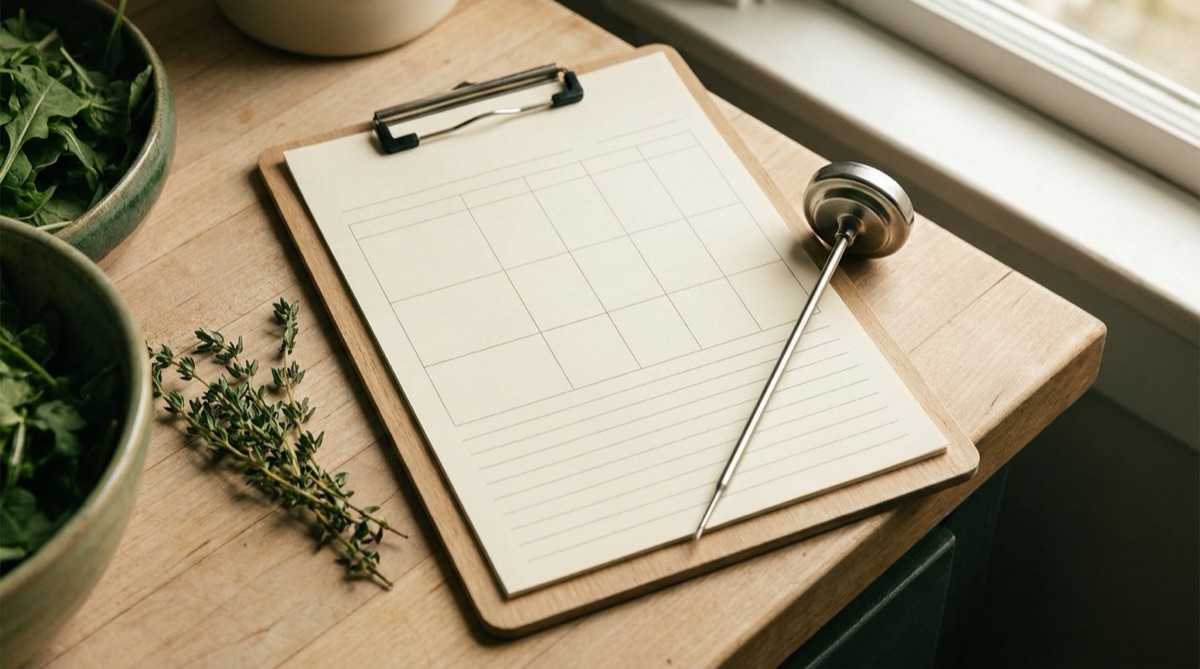
Every HACCP plan lives or dies on its records. A temperature log is the evidence that your monitoring actually happened — and in an audit or a foodborne illness investigation, the log is the only version of events that counts.
This guide covers what a compliant temperature log has to contain, how long to keep logs, the failures auditors catch most often, and when it makes sense to stop doing this by hand. If you just want the form, grab our free printable HACCP temperature log template and go.
The logs a food operation actually needs
A "temperature log" is really a family of records, each tied to a different critical control point:
- Cold and hot holding logs — routine checks of walk-ins, reach-ins, lowboys, and hot wells against the FDA Food Code limits of 41°F or below and 135°F or above.
- Cooling logs — batch-by-batch records proving cooked food passed the two-stage cooling checkpoints. These are the most demanding and the most-failed.
- Receiving logs — temperatures taken at the dock before deliveries are accepted.
- Cooking and reheating logs — internal temperatures confirming food hit its minimum before service or hot holding.
The anatomy below applies to all of them; the frequency and the critical limits change per record.
What a compliant temperature log needs
HACCP treats monitoring, corrective action, verification, and record-keeping as separate principles, and a good log captures all four on one sheet. At minimum, every entry needs:
- Date and time of the reading — actual clock time, not a shift name.
- The unit or item being measured — walk-in #2, prep-line lowboy, the batch of soup coming out of the kettle.
- The observed temperature — what the thermometer actually said.
- The critical limit — the target the reading is judged against, such as 41°F or below for cold holding per the FDA Food Code 2022.
- Corrective action — what was done when a reading missed the limit: product moved, discarded, unit serviced, maintenance called.
- Initials of the person who took the reading, plus a manager or PIC signature verifying the log was reviewed.
The corrective action column is the one that separates real logs from wallpaper. A 44°F reading with an empty box next to it is worse than no log at all — it documents that you saw a problem and did nothing.
How long do you have to keep temperature logs?
For restaurants and retail, the FDA Food Code does not set one national retention period — your local health department and your own HACCP plan do. Where federal HACCP regulations apply, the numbers are explicit: the FDA seafood HACCP rule (21 CFR 123.9) requires records kept 1 year for refrigerated products and 2 years for frozen or shelf-stable products, and FSMA preventive controls records must be kept 2 years (21 CFR 117.315).
A sensible retail default: keep the last 90 days on-site and reachable, and archive at least a full year. Old logs settle chargeback disputes, answer complaint investigations, and back you up with your insurer — long after the week they were written.
The audit failures that show up over and over
- Missing corrective actions. Out-of-range readings with no documented response — the single most common finding.
- Pencil-whipped logs. A week of identical 36°F entries in the same handwriting and the same pen, filled in minutes before the audit. Auditors have seen thousands of these; they are not fooled.
- Gaps. Weekends, holidays, the overnight shift — the exact windows when failures are most likely to go unnoticed.
- Impossible readings. A freezer logged at 0°F during the hours a defrost cycle or a power event says otherwise.
- No verification. Nobody signed off, so nobody was accountable for reviewing the record.
- Logs that end at the wrong time. Cooling checks that stop when the closer clocks out, hours before the food actually reached 41°F.
Manual vs. automated logging
A manual program can absolutely pass an audit — the template below is built for exactly that. The costs are the labor and the blind spots. Manual temperature checks run around 45 minutes a day in a typical restaurant, which at a loaded wage works out to thousands of dollars per location per year — run your own numbers in the savings calculator. And a clipboard only knows what the kitchen looked like at the moment someone was standing in front of the unit.
Automated logging flips the model: wireless sensors record every unit around the clock, the platform generates the HACCP log automatically, timestamps are tamper-proof, and corrective actions are prompted the moment a limit is breached instead of discovered at the next check. That is the difference between a record of four moments a day and a record of the whole day — see automated temperature logging for how it works.
The free template
Our printable HACCP temperature log is a clean, single-page form with columns for date, time, unit, reading, critical limit, corrective action, and initials, plus a manager verification line. Print a stack, clip one to each station, and it will hold up in front of a health inspector or a corporate auditor.
Use it well: take readings at the same times daily, write corrective actions immediately while details are fresh, review and sign weekly, and file completed sheets where you can actually find them in twelve months.
When to stop logging by hand
The honest threshold: when the labor cost of doing it right exceeds the cost of having it done automatically — for most multi-unit operators, that line was crossed a while ago. If your team is spending the better part of an hour a day walking coolers with a clipboard, book a demo and see what your logs look like when they write themselves.
Get the monthly cold-chain briefing
One email a month — food safety trends, compliance changes, and operator playbooks. No spam, ever.